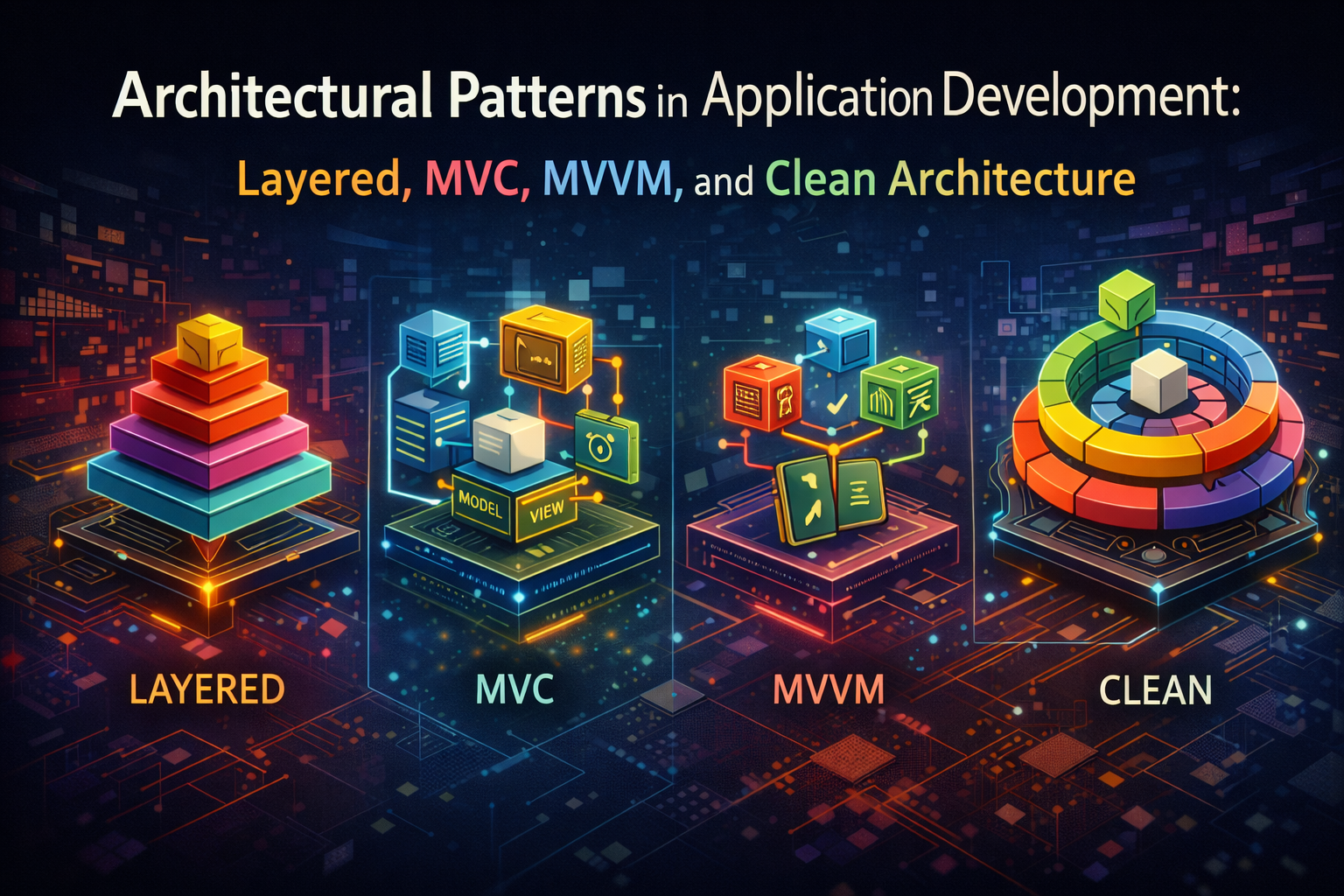
Modern application development is no longer defined only by programming languages, frameworks, or visual interfaces. As software systems grow in size, complexity, and longevity, their internal structure becomes one of the most important factors in determining whether they remain maintainable, scalable, testable, and understandable over time. This is where architectural patterns play a central role. They provide repeatable structural models for organizing application logic, separating concerns, and managing the relationship between user interfaces, business rules, data access, and infrastructure. Architectural patterns are not merely abstract design ideas. They shape how teams think about responsibility, dependency, change, and system evolution. A poorly structured application may still function in its early stages, but as requirements expand, technical debt accumulates, and new contributors join the codebase, weak architecture begins to impose real costs. Features become harder to implement, bugs become harder to isolate, testing becomes more difficult, and the system resists change. In contrast, a well-chosen architectural pattern helps software remain coherent as it grows. Among the most widely discussed patterns in application development are Layered Architecture, Model-View-Controller, Model-View-ViewModel, and Clean Architecture. Each emerged in response to practical problems in software design. Each offers a different way of structuring application concerns. And each has strengths, limitations, and contexts in which it is most effective. This article examines these four major architectural patterns in a professional and structured way. It explains their principles, internal organization, practical benefits, trade-offs, and the kinds of applications in which they are commonly used. More importantly, it shows that architectural patterns should not be treated as trends to imitate blindly, but as design tools to be understood and applied deliberately.
Why Architectural Patterns Matter in Application Development
Application architecture is the structural foundation of a software system. It defines how the major parts of the application are organized, how they interact, and how responsibilities are distributed. Without a clear architecture, the codebase often grows in an ad hoc manner, driven by immediate feature demands rather than long-term design coherence. Architectural patterns matter because they impose structure where complexity would otherwise spread unchecked. They help developers answer fundamental questions. Where should business logic live? How should the user interface interact with application state? How should data access be isolated from domain rules? How can different parts of the application evolve without breaking each other? These are not small implementation questions. They determine whether the application can be changed safely and maintained economically over time. Patterns also support communication within teams. When developers share a common architectural vocabulary, they can reason more effectively about boundaries, dependencies, and responsibilities. A pattern such as MVC or Clean Architecture does not eliminate all design decisions, but it provides a conceptual framework within which those decisions can be made more consistently. It is also important to recognize that architectural patterns are not universal solutions. A pattern that works well for a desktop application may not be the best choice for a cloud-native backend. A pattern that improves testability may introduce more abstraction than a small project truly needs. Understanding patterns therefore requires understanding both their principles and their trade-offs.
Understanding Layered Architecture
Layered Architecture is one of the oldest and most widely used structural patterns in application development. It organizes software into horizontal layers, each with a distinct responsibility. Although specific naming conventions vary, the most common arrangement includes presentation, application or service, domain or business logic, and data access or persistence layers. The central idea behind this pattern is separation of concerns through progressive abstraction. The presentation layer handles user interaction and display logic. The business or domain layer contains the application’s core rules and workflows. The data layer manages database operations and persistence concerns. Each layer is responsible for a particular class of behavior, and communication typically moves in a controlled direction from top to bottom. This structure makes the application easier to understand because responsibilities are grouped logically. A developer looking for user interface behavior knows where to look. A developer modifying database interaction does not need to search through presentation code. Layered Architecture is especially common in enterprise systems, traditional web applications, internal business platforms, and backend systems built around service-oriented logic. One of its greatest strengths is simplicity. It is intuitive, easy to explain, and supported naturally by many frameworks. Teams can adopt it without large conceptual overhead. It also supports maintainability when implemented carefully, because each layer can evolve somewhat independently from the others. However, Layered Architecture has limitations. In practice, teams often allow business logic to leak into controllers, database concerns to leak into service classes, or shared utilities to bypass proper boundaries. When this happens, the apparent clarity of the layers becomes superficial. Another challenge is that strict layering can sometimes introduce unnecessary indirection, especially in smaller applications where the number of layers exceeds the real complexity of the problem. Even so, Layered Architecture remains a foundational pattern because it teaches one of the most important lessons in application design: different responsibilities should not be mixed casually. It may not always be sufficient on its own, but it often provides the conceptual starting point for more sophisticated approaches.
Model-View-Controller and the Separation of Interaction Concerns
Model-View-Controller, commonly known as MVC, is one of the most influential architectural patterns in the history of application development. Originally designed for user-interface-driven systems, it became especially prominent in desktop software and later in web development frameworks. MVC divides an application into three main components. The Model represents application data and, in some interpretations, certain business rules. The View is responsible for rendering information to the user. The Controller acts as an intermediary that receives user input, interprets requests, coordinates with the model, and determines what view should be returned or updated. The purpose of MVC is to separate data, presentation, and interaction flow. This makes user interfaces easier to manage, especially when an application supports multiple views over the same data or when input handling becomes nontrivial. In traditional server-side web frameworks, the controller receives the HTTP request, interacts with the model or service layer, and selects a view template for rendering the response. MVC became highly popular because it mapped naturally onto web application concerns. Frameworks in multiple ecosystems adopted it as a default organizational model, and for many teams it served as the first formal introduction to architectural thinking beyond simple scripts or procedural flows. Its strengths are clear. MVC provides a straightforward conceptual division of responsibilities. It improves code organization relative to monolithic page logic. It supports reuse of models and views to some extent. It also helps developers avoid mixing raw input handling directly with presentation output. Yet MVC has also been widely misunderstood and inconsistently implemented. In many real-world codebases, controllers become overly large and accumulate responsibilities that belong elsewhere. Business logic drifts into models in ways that make them bloated and difficult to test. Views may begin to contain conditional logic that exceeds pure presentation concerns. The result is often an application that technically follows MVC terminology while failing to preserve real architectural clarity. Another limitation is that MVC was designed in contexts that differ from some modern reactive and state-driven UI environments. In such cases, patterns like MVVM may provide better alignment with data binding and interface synchronization needs. Still, MVC remains highly relevant because it established a critical architectural principle: user interfaces should not directly own all application behavior. There should be an organizing structure that mediates between data, display, and input flow.
Model-View-ViewModel and the Rise of State-Oriented UI Design
Model-View-ViewModel, or MVVM, emerged as a refinement of UI architecture for environments where data binding and reactive interface updates play a central role. It is especially associated with desktop technologies such as WPF and modern client-side frameworks in which UI state changes dynamically in response to underlying data and commands. Like MVC, MVVM separates concerns related to data and presentation, but it introduces a different intermediary: the ViewModel. The View remains responsible for the visual interface. The Model represents domain data or business entities. The ViewModel acts as an abstraction of the View, exposing the data, state, and commands that the View needs in a form suited for presentation. In many implementations, the View binds directly to properties and commands on the ViewModel. This architecture is particularly effective in applications where the UI must reflect complex state changes in a structured and testable way. Instead of the view manually pulling values and invoking procedural logic, it reacts to data exposed by the ViewModel. This enables cleaner UI composition, stronger testability of presentation behavior, and better support for reactive or declarative interface frameworks. MVVM’s major strength lies in its treatment of the user interface as a projection of state rather than a place where procedural control logic should dominate. The ViewModel becomes the center of presentation behavior. It translates domain data into view-friendly formats, handles user intent through commands, and manages validation or interaction-related state without forcing that logic into the view itself. This separation is highly valuable in large frontend or desktop applications where presentation state becomes complex. Testing also improves, because ViewModel logic can often be verified independently of the actual rendered UI. In environments with robust binding systems, MVVM can lead to elegant and highly maintainable interfaces. At the same time, MVVM introduces its own challenges. Poorly designed ViewModels can become bloated and accumulate too much responsibility. Excessive binding complexity can make debugging difficult. In smaller applications, MVVM may add abstraction without enough return. There is also variability in how the pattern is interpreted, especially in JavaScript ecosystems, where state management libraries, component systems, and reactive patterns may overlap with or substitute for classical MVVM ideas. Even so, MVVM remains one of the most important patterns for applications with rich user interfaces because it reflects a mature understanding of the relationship between interface state and application behavior.
Clean Architecture and Dependency Control
Clean Architecture represents a more explicitly principled and abstract architectural model than the previously discussed patterns. Popularized as a way to protect business rules from framework, interface, and infrastructure dependencies, it focuses on the direction of dependency and the preservation of domain-centric design. The core idea of Clean Architecture is that the most important business logic should exist at the center of the application and should not depend on external details such as databases, frameworks, user interfaces, or delivery mechanisms. These external elements are treated as outer layers, while entities and use cases occupy the inner layers. Dependencies flow inward, never outward. The domain does not know about the database. The application rules do not know about web frameworks. Infrastructure implements interfaces defined closer to the business core. This pattern is deeply concerned with maintainability, independence, and testability. By isolating business rules from infrastructure, Clean Architecture aims to make the application more stable in the face of changing frameworks, databases, interfaces, or deployment strategies. It becomes easier to test use cases without involving external systems. It also becomes easier to replace technical details because those details are not allowed to shape the core of the system. In practical terms, Clean Architecture often includes entities, use cases, interface adapters, and frameworks or drivers. Entities contain enterprise-wide business rules. Use cases define application-specific workflows. Interface adapters translate between external formats and internal models. The outermost layer contains technical details such as web frameworks, databases, and external services. One of the most significant advantages of Clean Architecture is its emphasis on protecting core business logic from volatility. Many frameworks come and go. Databases change. UI layers evolve rapidly. Business rules, however, often have longer-lasting value. Clean Architecture tries to ensure that the most important logic remains insulated from technical churn. Its limitations are primarily related to complexity and cost of abstraction. For small or short-lived projects, the full structure may feel heavy. Teams unfamiliar with dependency inversion may implement it mechanically rather than meaningfully, resulting in unnecessary interfaces, indirection, and ceremony. Clean Architecture requires architectural discipline. It works best when the application has enough complexity or longevity to justify the investment. Despite these trade-offs, Clean Architecture has become highly influential because it addresses a major weakness in many software systems: the tendency for frameworks and infrastructure choices to dominate the entire codebase. It reorients architecture around business rules rather than tools.
Comparing the Four Patterns
Although Layered Architecture, MVC, MVVM, and Clean Architecture all aim to improve software structure, they do so from different perspectives. Layered Architecture focuses on broad responsibility separation across levels of abstraction. MVC focuses on organizing interaction between user input, display, and application data. MVVM refines UI-state architecture by introducing a presentation-oriented abstraction suited for data binding and reactive interfaces. Clean Architecture focuses on dependency direction and the protection of core business logic from technical details. Layered Architecture is often the most straightforward and easiest to introduce. It provides clarity in many traditional systems, but may not adequately protect business rules from infrastructure leakage without additional discipline. MVC is highly effective for structuring request-handling and interface flows, especially in classic web frameworks, but it is vulnerable to overgrown controllers and ambiguous model responsibilities. MVVM shines in state-driven interfaces and improves testability of presentation logic, but can become verbose or overly abstract if not justified by UI complexity. Clean Architecture offers strong long-term maintainability and domain protection, but it requires more conceptual maturity and a willingness to manage abstraction thoughtfully. These patterns are not always mutually exclusive. In fact, real applications often combine them. A system may use Clean Architecture at the overall structural level, Layered Architecture within certain modules, and MVC or MVVM within specific delivery layers. The question is not which one is universally best. The more important question is which one solves the structural problem at hand with appropriate complexity.
Choosing the Right Pattern for the Right Context
Architectural decisions should always be shaped by context. The size of the team, the expected lifetime of the application, the complexity of the business rules, the volatility of the user interface, and the required level of testability all influence which pattern is appropriate. Layered Architecture is often a practical choice for standard business applications, administrative platforms, and systems where clear separation between presentation, logic, and persistence is sufficient. It works well when simplicity and familiarity are important. MVC remains useful for web applications built around request-response flows and server-rendered interfaces, especially when the framework ecosystem naturally supports the pattern. It is also a strong teaching model because it introduces structured interface design without overwhelming abstraction. MVVM is particularly well suited to rich client applications, mobile interfaces, and reactive front-end systems where data binding, state management, and presentation logic are central concerns. It becomes more valuable as the UI grows in complexity. Clean Architecture is most appropriate when business rules are substantial, system longevity matters, testing of core logic is essential, and there is real value in isolating the domain from technological volatility. It is especially powerful in large applications, enterprise systems, complex backend platforms, and products expected to evolve significantly over time. The wrong architectural choice is often not the one that is theoretically imperfect, but the one that introduces either too little structure or too much premature structure. Good architecture is proportional. It should solve real problems, not perform conceptual elegance for its own sake.
Common Mistakes in Applying Architectural Patterns
A recurring problem in software development is the superficial adoption of architectural vocabulary without genuine structural discipline. Teams may say they are using MVC while allowing controllers to become full application engines. They may claim to use Layered Architecture while bypassing layers whenever it feels convenient. They may adopt Clean Architecture and create unnecessary interfaces for every class, even when no abstraction boundary is truly needed. Another common mistake is confusing pattern names with architectural success. Using a recognized pattern does not guarantee a well-structured system. The quality of the implementation matters more than the label. A simple layered application with strong boundaries may be healthier than a poorly executed Clean Architecture codebase full of accidental complexity. Developers also sometimes treat patterns as universal templates rather than context-dependent tools. This leads to over-engineering, especially in small projects. Architecture should serve the problem, not dominate it unnecessarily. A final mistake is ignoring evolution. Applications change, and architecture should adapt accordingly. A pattern that was appropriate at one stage may require refinement later. Good architecture is not static. It is maintained through feedback, refactoring, and continual alignment between design and actual system needs. Architectural patterns in application development are essential because they provide structured ways to manage complexity, distribute responsibility, and protect software from chaos as it grows. Layered Architecture, MVC, MVVM, and Clean Architecture each represent important responses to recurring design challenges. Each offers a distinct model of organization, and each can be highly effective when used in the right context and implemented with discipline. Layered Architecture emphasizes broad responsibility separation. MVC structures the relationship between data, views, and user interaction. MVVM refines UI design through state-oriented presentation logic. Clean Architecture prioritizes dependency control and business-rule protection. Together, these patterns reflect an evolution in software thinking: from simple structural grouping to deeper control over coupling, testability, and long-term maintainability. No single pattern is best for every application. The most effective architectural decisions are those grounded in the realities of the product, the team, the domain, and the expected rate of change. Good architecture is not about choosing the most fashionable pattern. It is about choosing the structure that allows the application to remain clear, adaptable, and reliable over time. In modern development, where applications are expected to evolve continuously while remaining stable and understandable, architectural patterns are not academic luxuries. They are practical tools for building software that lasts. Understanding them is therefore not only useful for architects, but for every serious developer who wants to move beyond writing code that merely works toward designing systems that can endure.