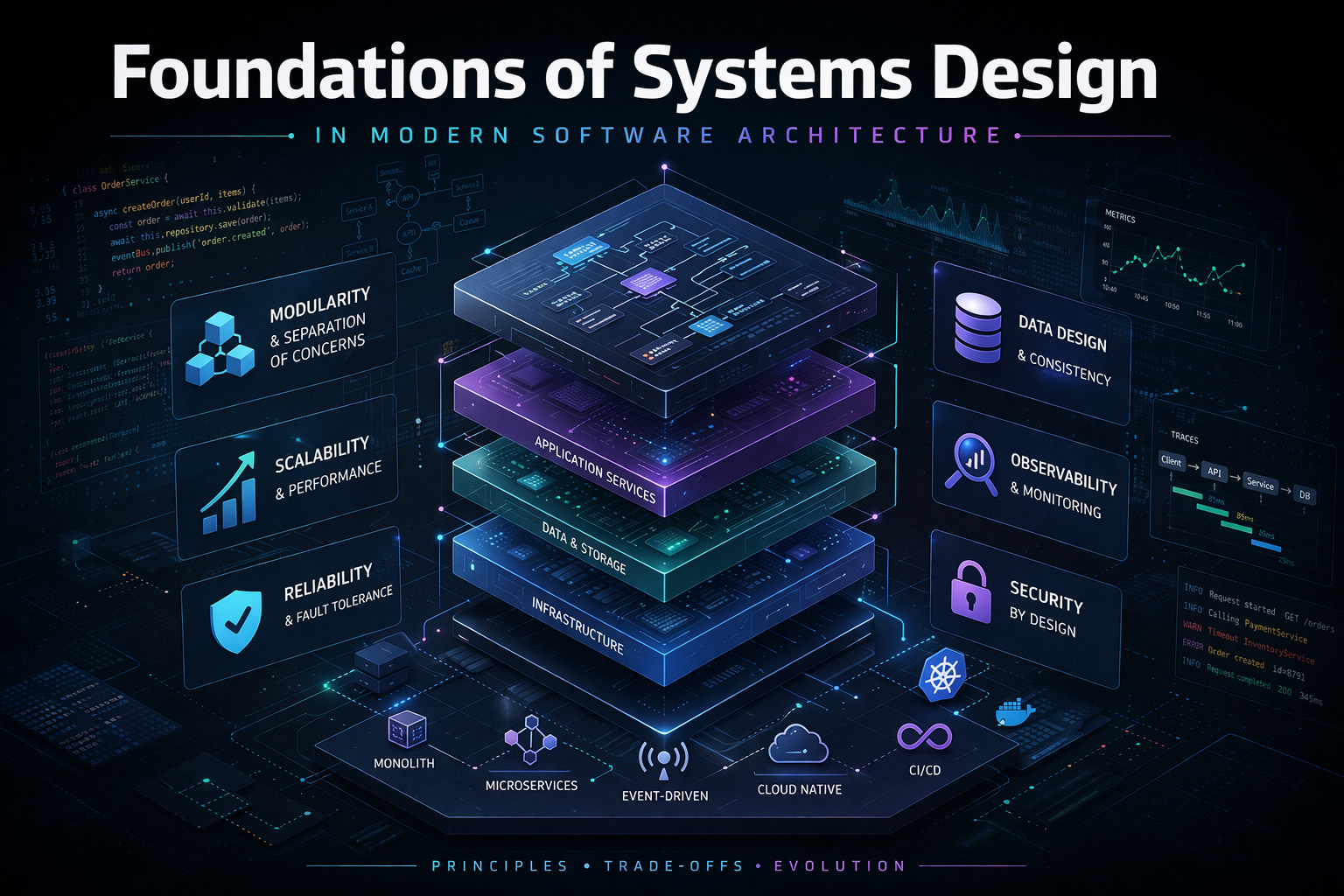
Modern software systems are no longer simple programs operating in isolation. They are interconnected, distributed, and expected to serve users across regions, devices, and networks while maintaining speed, reliability, and security under changing conditions. As software products grow in complexity, the ability to design systems thoughtfully becomes one of the most important skills in engineering. Systems design is not merely about drawing diagrams or choosing technologies. It is the discipline of shaping software structures that can support real-world requirements over time. In contemporary software architecture, systems design forms the bridge between business needs and technical implementation. It defines how components are divided, how services communicate, how data is stored and retrieved, how failures are handled, and how systems evolve without collapsing under their own complexity. A strong foundation in systems design enables teams to create software that is maintainable, scalable, observable, and resilient rather than fragile and difficult to extend. This article explores the foundations of systems design in modern software architecture. It examines the core principles that guide architectural decision-making, the major concerns that influence system structure, and the trade-offs that engineers must navigate when designing software for modern environments.
What Is Systems Design?
Systems design is the process of defining the structure, behavior, and interaction of software components in order to meet functional and non-functional requirements. Functional requirements describe what the system must do: authenticate users, process payments, store posts, send notifications, or generate reports. Non-functional requirements describe how well the system must perform these tasks: how quickly, how securely, how reliably, and at what scale. In practical terms, systems design asks questions such as:
- How should the application be divided into modules or services?
- How will the system handle growth in traffic or data volume?
- How should data be modeled and stored?
- What happens when one component fails?
- How will the system be monitored in production?
- How can new features be added without destabilizing the whole system?
These questions reveal that systems design is broader than coding. It sits at the architectural level, where technical decisions must align with business priorities, operational realities, and long-term maintainability.
Why Systems Design Matters in Modern Architecture
In modern software architecture, systems rarely remain small for long. Products begin with a manageable codebase, a narrow feature set, and limited traffic, but success introduces new demands. More users generate more load. More features increase coupling. More integrations expand the system boundary. More developers require clearer interfaces and stronger internal structure. Without sound systems design, growth often leads to instability. Performance degrades, deployments become risky, debugging becomes painful, and every new feature introduces unexpected side effects. Poor architecture may still work temporarily, but it becomes increasingly expensive to operate and evolve. Good systems design addresses this by creating order. It establishes boundaries, allocates responsibilities, clarifies communication paths, and anticipates change. This does not mean over-engineering every product from day one. It means building with principles that support evolution rather than accumulation of technical chaos.
Core Principle 1: Separation of Concerns
One of the most foundational ideas in systems design is separation of concerns. Different parts of the system should handle different responsibilities, and those responsibilities should be explicit. When logic is scattered or entangled, systems become difficult to understand and modify. For example, a well-structured system separates presentation logic from domain logic, business rules from infrastructure details, and data access from transport protocols. In a web application, the front end should not implement core authorization rules independently from the backend. Similarly, database queries should not be mixed carelessly with controller logic or user interface code. Separation of concerns does not guarantee perfect design, but it creates the conditions for maintainability. Engineers can reason about one part of the system without needing to understand every other part at the same time. Testing becomes easier. Refactoring becomes safer. New features can be implemented with less unintended disruption. In modern software architecture, this principle appears at multiple levels: within classes, between modules, across services, and even between infrastructure layers.
Core Principle 2: Modularity and Clear Boundaries
Closely related to separation of concerns is modularity. A module is a unit of software that encapsulates a specific responsibility behind a defined interface. Good modular design allows engineers to change internal implementation without forcing unrelated parts of the system to change. Modularity is valuable because modern software systems evolve continuously. If every change requires touching many unrelated areas, velocity slows and error risk rises. A modular architecture limits the blast radius of change. Clear boundaries also support team collaboration. When different teams own different domains or services, ambiguous boundaries create conflict, duplication, and coupling. Strong boundaries help define ownership, reduce accidental dependencies, and improve accountability. This is why domain-driven thinking has become influential in modern architecture. When modules are organized around meaningful business capabilities rather than technical convenience alone, the system structure often becomes more intuitive and sustainable.
Core Principle 3: Scalability as a Design Concern
Scalability refers to the system’s ability to handle growth in users, requests, data volume, or computational demand without unacceptable degradation. It is one of the most frequently discussed topics in systems design, but it must be understood carefully. Scalability is not only about serving millions of users. It is about designing systems that can grow predictably. A system that works only under ideal conditions is not well designed, even if it performs well in early testing. There are different forms of scalability. Vertical scaling increases resources on a single machine. Horizontal scaling distributes work across multiple machines or instances. Stateless application layers are generally easier to scale horizontally, while stateful components such as databases require more careful design. Scalability also depends on workload characteristics. Read-heavy systems may benefit from caching and read replicas. Write-heavy systems may require partitioning strategies. Real-time systems may face concurrency bottlenecks. Compute-heavy systems may need asynchronous job processing. The key lesson is that scalability is not solved by one technology. It emerges from the overall architecture: data design, communication patterns, caching strategy, service boundaries, and operational practices.
Core Principle 4: Reliability and Fault Tolerance
Modern systems must assume that failure is inevitable. Networks fail. disks fail. services timeout. third-party APIs return errors. deployments introduce bugs. Systems design must therefore include failure as a first-class concern. Reliability is the property of behaving consistently and correctly over time. Fault tolerance is the ability to continue operating, at least partially, even when components fail. Together, they define how resilient a system is under stress and disruption. Reliable design often includes redundancy, retries, circuit breakers, health checks, failover strategies, graceful degradation, and isolation mechanisms. A payment service, for example, may retry transient failures but avoid infinite repetition. A notification system may place failed jobs into a dead-letter queue for later inspection. A frontend may continue functioning with limited capability if a recommendation service becomes unavailable. An important architectural insight is that fault tolerance is not about pretending failure does not happen. It is about controlling how failure propagates. Systems with weak boundaries often fail catastrophically because one issue spreads across the entire architecture. Systems with stronger isolation degrade more gracefully.
Core Principle 5: Data Design and Consistency
Data is central to nearly every software system. Systems design must therefore address not only where data is stored, but how it is structured, accessed, replicated, and protected. Relational databases remain fundamental because they provide consistency, transactions, and structured querying. They are often ideal for systems where correctness matters deeply, such as orders, billing, identity, and permissions. NoSQL systems may be more suitable for flexible schemas, high-speed key-value access, event logs, or large-scale distributed workloads. The deeper issue in systems design is not simply choosing SQL or NoSQL. It is understanding the trade-offs between consistency, availability, latency, throughput, and complexity. In distributed systems, strong consistency may reduce availability or increase coordination costs. Eventual consistency may improve scalability but require application-level tolerance for stale reads or delayed synchronization. Good data design also requires clear ownership. If multiple services update the same data without clear authority, inconsistency becomes likely. Modern architectures increasingly emphasize that each service or module should own its data boundaries and expose interaction through contracts rather than shared database access.
Core Principle 6: Performance and Efficiency
Performance is often misunderstood as a narrow optimization problem. In reality, performance is a systems design concern because it reflects the structure of the architecture itself. Latency, throughput, memory use, and resource efficiency are not determined only by coding style. They are influenced by communication patterns, storage design, concurrency models, and workload distribution. A system that requires many synchronous service calls to complete one user request may suffer high latency even if each component is individually fast. A data model that causes repeated expensive queries may degrade performance under scale. Large payloads, excessive serialization, and inefficient caching strategies all affect system behavior. Performance design often involves reducing unnecessary work, shortening critical paths, distributing load intelligently, and caching repeated results. It may also involve asynchronous processing for tasks that do not need to block the main request path. In modern architecture, performance is closely linked to user experience and infrastructure cost. A slow system frustrates users, but it also consumes more resources and becomes harder to scale economically.
Core Principle 7: Observability and Operational Visibility
A system that cannot be observed cannot be operated effectively. This principle has become more important as architectures have grown more distributed. In a monolithic system, developers may still debug by reading logs and stepping through code locally. In a multi-service production system, this is no longer sufficient. Observability refers to the ability to understand system behavior from external outputs such as logs, metrics, traces, events, and alerts. It allows teams to investigate incidents, detect regressions, diagnose bottlenecks, and understand how requests move through the architecture. Metrics provide quantitative signals such as latency, error rate, throughput, and resource usage. Logs capture contextual details about events and failures. Distributed traces show how a request flows across services. Alerts notify teams when thresholds or anomaly patterns indicate a problem. Observability is not an afterthought. It must be designed into the system. Critical workflows should emit meaningful telemetry. Errors should be structured and actionable. Correlation identifiers should exist so cross-service interactions can be traced. Operational readiness is part of architectural quality.
Core Principle 8: Security by Design
Security is not a feature added at the end of development. It is a structural property of the system. Modern software architecture must consider authentication, authorization, encryption, secret management, auditability, input validation, rate limiting, and trust boundaries from the beginning. Security by design means reducing attack surface, enforcing least privilege, and ensuring that security controls exist at appropriate boundaries. A public API should validate requests rigorously. Internal service communication should not automatically be trusted merely because it happens inside a private network. Sensitive data should be protected both in transit and at rest. Secrets should not be hardcoded or handled casually. Architecturally, security also means understanding where trust changes. A browser request, an admin action, an internal service call, and a third-party webhook do not belong to the same trust domain. Systems design must reflect these distinctions clearly. In modern distributed environments, security also intersects with observability and reliability. Teams need audit trails, anomaly detection, and incident response visibility. A secure system is not one that is impossible to attack; it is one that is designed to resist, detect, and contain threats effectively.
Architectural Styles in Modern Systems Design
Modern software architecture includes several common structural styles, each with strengths and trade-offs. A monolithic architecture keeps the application in a single deployable unit. This can be highly effective for early-stage products or systems whose complexity does not justify distribution. A well-designed monolith is often simpler to test, deploy, and reason about than a fragmented set of services. A modular monolith improves on this by enforcing strong internal boundaries while preserving a single deployment artifact. Many teams now view this as an excellent balance between simplicity and maintainability. Microservices divide the system into independently deployable services aligned with business capabilities. This can improve scaling and team autonomy, but it introduces distributed systems complexity: network latency, partial failures, tracing challenges, versioning concerns, and operational overhead. Event-driven architectures organize interaction around events rather than synchronous request chains. They can improve decoupling and scalability, especially for asynchronous workflows, but they require careful handling of consistency, idempotency, and event ordering. The key lesson is that architectural style should follow context. No style is universally superior. Systems design is the art of choosing appropriately, not imitating fashionable patterns.
Trade-Offs and the Reality of Design Decisions
One of the most important truths in systems design is that every architectural decision involves trade-offs. You can improve one quality attribute at the cost of another. Strong consistency may reduce availability. Deep modularity may introduce abstraction overhead. Caching may improve speed but complicate invalidation. Microservices may improve team independence while increasing operational complexity. This is why systems design is not about memorizing best practices in isolation. It is about evaluating priorities. What matters most for this product at this stage? What are the likely failure modes? Which constraints are non-negotiable? What complexity is justified, and what is premature? Good architects do not aim for perfection. They aim for alignment between design choices and real requirements. They also document assumptions clearly, because many failures in architecture come not from bad ideas, but from hidden assumptions that were never reexamined.
Evolution and Maintainability
A strong system is not one that never changes. It is one that can change without collapsing. Modern software architecture must therefore support evolution. Maintainability depends on readable code, explicit boundaries, consistent conventions, reliable testing, safe deployment practices, and clear documentation. It also depends on limiting accidental complexity. Systems accumulate complexity naturally as they grow. Good systems design works actively to contain that growth. This is why refactoring is part of architecture, not separate from it. Design decisions made early may need revision as the system scales or product direction changes. Architecture should not be treated as a frozen diagram. It is a living structure that must be reevaluated continuously. The foundations of systems design in modern software architecture rest on a set of enduring principles: separation of concerns, modularity, scalability, reliability, data integrity, performance awareness, observability, security, and careful trade-off analysis. These foundations help engineers create systems that not only work today but continue to work as requirements, teams, and workloads evolve. Modern software systems operate in environments defined by uncertainty, distribution, and continuous change. Under those conditions, systems design becomes more than technical planning. It becomes a discipline of controlled complexity. It determines whether software remains understandable or becomes chaotic, whether it degrades gracefully or fails catastrophically, and whether it can evolve sustainably or becomes trapped by its own structure. The most effective architects and engineers are not those who memorize the most patterns, but those who understand the principles beneath them. Technologies change, frameworks rise and fall, and deployment models evolve, but the foundations of sound systems design remain remarkably consistent. To master modern software architecture, one must first understand these foundations, because they are what transform code into durable systems.