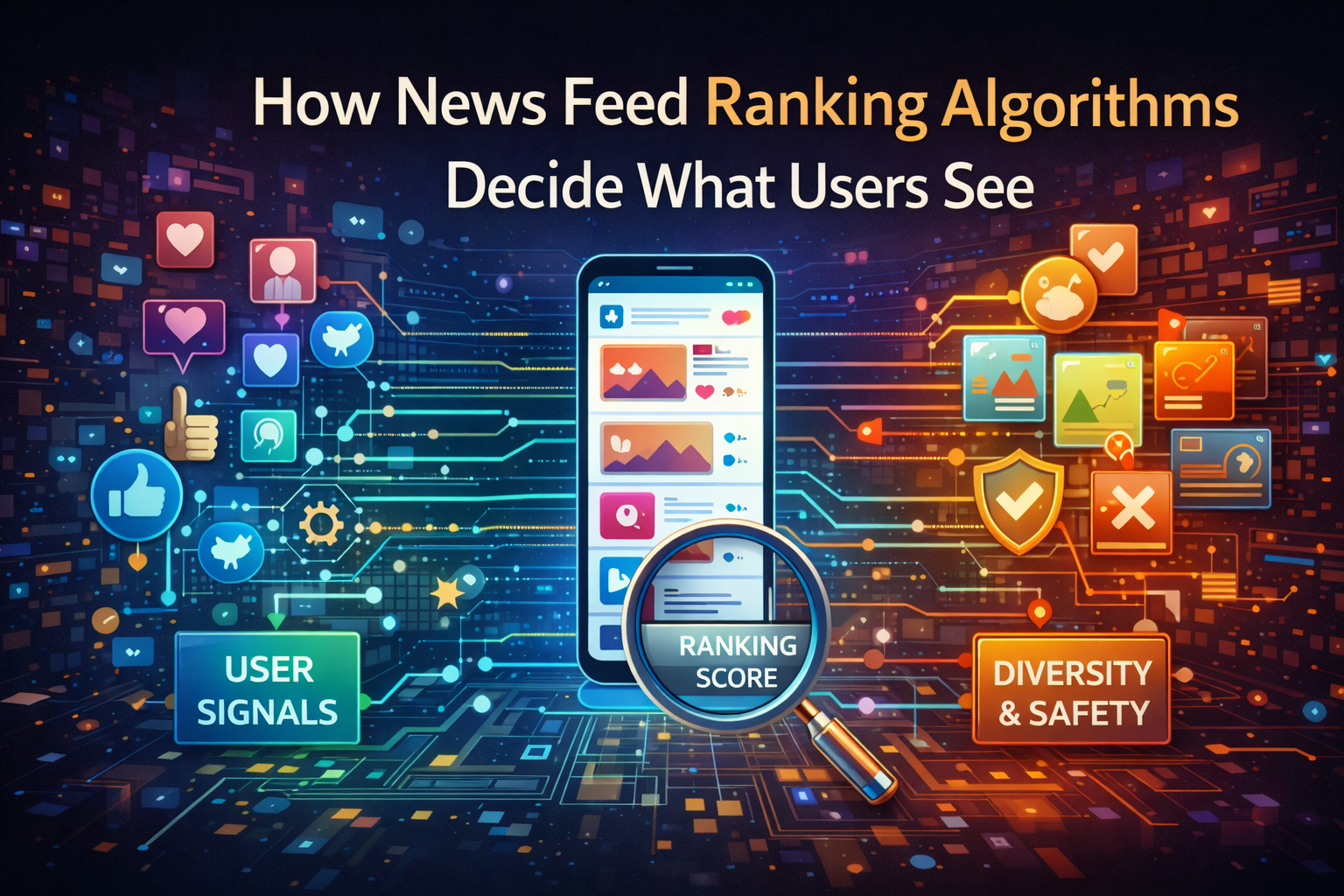
News feed ranking is one of the most influential mechanisms in modern digital platforms. Whether the surface is called Feed, For You, Home, Explore, or Timeline, the core problem is similar: a platform usually has far more content than a person can reasonably consume, so it must decide what to show first, what to delay, and what not to show at all. Meta describes feed ranking as the process of organizing available stories so the most relevant items appear at the top, while TikTok explains its recommenders as systems that select from a large pool of eligible content and rank items by how likely a user is to be interested in them.
At a high level, ranking algorithms are not simply “sorting by popularity.” They combine many signals about the user, the content, and the surrounding context, then use predictive models to estimate what will be most valuable, interesting, or useful for that specific person at that specific moment. Meta says its systems combine many predictions rather than relying on any single signal, and TikTok likewise says recommendations are based on a combination of user interactions, content information, and user information.
What makes this technically important is scale. Large platforms may have millions or billions of potential items competing for attention. Meta’s engineering posts describe ranking funnels with sourcing, early-stage ranking, and late-stage ranking, while YouTube’s published recommendation architecture similarly separates candidate generation from ranking so it can search a huge corpus efficiently before scoring a much smaller set in detail.
This article explains how modern news feed ranking algorithms decide what users see. It focuses on the general architecture behind feed ranking rather than on one product alone, using public technical descriptions from Meta, TikTok, X, and Google to show how retrieval, prediction, re-ranking, filtering, and feedback work together in production systems.
Ranking Is Usually a System, Not a Single Algorithm
One of the biggest misconceptions about feeds is the idea that there is one master formula deciding everything. In practice, platforms describe multiple models, multiple surfaces, and multiple stages. Meta says its apps use AI systems, plural, to rank content across Feed, Stories, Reels, and other surfaces, and in 2025 Meta engineering wrote that Instagram had scaled to more than 1000 ML models supporting different parts of ranking and recommendation.
That matters because a feed is usually not one ranking problem. It includes different content types, different business objectives, different safety rules, and different latency constraints. The model that predicts whether you will comment on a post is not necessarily the same model that predicts whether you will watch a video to completion, follow a creator, hide a post, or report content. Meta explicitly says its systems use a wide variety of predictions in combination, because no single prediction is a perfect measure of value.
So when people say “the algorithm,” they are usually compressing an entire pipeline into one phrase. In engineering terms, a feed is much closer to a coordinated ranking stack than to one standalone formula.
Step 1: Build the Candidate Set
Before a platform can rank content, it has to decide what content is even eligible to be ranked. Meta’s simpler public explanation of Facebook Feed breaks ranking into four elements: inventory, signals, predictions, and a relevancy score. The first of those, inventory, is the set of stories available at that moment.
In modern large-scale systems, that inventory is often narrowed through a candidate-generation stage. Meta engineering describes Instagram ranking as a funnel with sourcing or retrieval first, then early-stage ranking, then late-stage ranking. YouTube’s recommendation paper describes the same basic pattern: candidate generation shrinks a corpus of millions down to hundreds, and ranking then scores those candidates more precisely.
X’s published recommendation repository shows this structure very clearly. Its For You Timeline combines multiple candidate sources, including in-network posts, graph-based candidate retrieval, and recommendation services, before applying ranking and post-mixing. The repository also notes that roughly half of posts come from an in-network source in that specific architecture snapshot.
This candidate stage is essential because ranking every possible item in full detail would be too expensive. The first job of the system is therefore not “find the final best post,” but “find a manageable set of plausible posts worth scoring more carefully.”
Step 2: Collect Signals About the User and the Content
Once candidate items are available, the system needs features or signals that describe both the viewer and the content. Meta explicitly calls these inputs “signals,” and TikTok groups them into three main categories: user interactions, content information, and user information.
User interactions are usually the strongest signals. TikTok lists likes, shares, follows, comments, and created content among the factors used for recommendations. X’s repository similarly mentions explicit signals such as likes and replies, along with implicit signals such as profile visits and tweet clicks. These signals matter because they are direct evidence of preference or attention.
Content information also matters. TikTok says this includes things like captions, sounds, and hashtags. Meta’s 2021 engineering post about News Feed gives examples such as who is tagged in a photo, when the post was made, and the relationship between the viewer and the creator. These are not just metadata fields; they are inputs the models can use to estimate relevance, freshness, and likely engagement.
User information tends to matter too, but often with lower weight than direct behavioral feedback. TikTok explicitly says device and account settings such as language, country, and device type are included mainly to optimize the experience, but usually receive lower weight than stronger preference signals because they are not active expressions of interest.
Step 3: Predict What the User Is Likely to Do
Modern feed ranking usually works by making predictions. Meta says its AI systems predict how valuable a piece of content might be, and that one example is predicting whether a user will share a post. Its public explanation of Feed ranking also says the platform makes predictions such as how likely you are to comment on or share a story.
This predictive layer is what turns raw signals into actionable ranking. The platform is not only asking what content exists. It is asking what outcomes are likely if this user sees this item now. Those outcomes might include clicking, watching, commenting, liking, hiding, following, reporting, or returning later. Meta’s engineering post on News Feed makes this idea explicit by framing ranking as prediction over user-item features and then optimizing for the value of showing a post to a viewer.
YouTube’s recommendation paper describes a similar two-stage architecture in which a ranking network assigns a score to each candidate according to the desired objective function using a rich set of user and video features. X’s repository also points to a heavy-ranker neural network that helps choose timeline posts after candidate sourcing.
This is one reason feed ranking is often misunderstood. People imagine the system reading content in a human-like way and deciding what is “best.” In reality, the system is more often estimating probabilities and expected value across many possible user behaviors, then combining those estimates into a final score.
Step 4: Turn Predictions Into a Ranking Score
Predictions alone are not enough. The system still needs a way to combine them into a score that can order items. Meta’s public ranking explanation says this final step is a relevancy score for each story, based on available inventory, signals, and predictions.
The important detail is that feed ranking is usually multi-objective, even if the final output is a single ordered list. A platform may want to balance comments, shares, watch time, dwell time, satisfaction, survey feedback, creator discovery, safety, and long-term retention. Meta says it uses many predictions in combination, including behavioral signals and survey-based feedback, because no single prediction fully captures value.
YouTube’s published system also emphasizes objective choice. Its ranking network is trained around a desired objective function, and the paper notes that final evaluation depends on live A/B testing because offline metrics do not always match real user response. That same logic applies broadly to feed systems: ranking is not just a technical accuracy problem but an optimization problem over product goals.
This is why two platforms can look similar from the outside yet behave differently. If one system weights comments heavily and another values completion rate or satisfaction surveys more, the visible feed can diverge even with similar candidate pools and features.
Step 5: Re-Rank, Mix, and Filter
The first ranking pass is rarely the last step. Platforms usually perform additional post-processing to mix sources, avoid repetition, apply policy constraints, and shape the final feed. X’s published architecture separates candidate sourcing, ranking, and post mixing and filtering. Its repository also lists visibility filters that support legal compliance, product quality, trust, and downranking.
TikTok likewise says its recommenders try to avoid excessive repetition. The company states that a For You feed generally will not show two videos in a row with the same sound or by the same creator, and that duplicated content, already-seen content, or spam is not recommended. Its support documentation also says it generally will not recommend two posts in a row from the same creator in certain feeds.
Meta also says signals are used not only for relevance but to identify harmful content and reduce the distribution of problematic or low-quality material. In other words, ranking is not purely about “what you might click.” It is also about what the platform is willing to distribute and in what form.
So the final feed is usually the result of ranking plus constraints. The most relevant post according to one model may still be demoted, filtered, or mixed differently for safety, policy, quality, or diversity reasons.
Diversity Matters, Not Just Relevance
If a feed optimized only for short-term similarity, it could become repetitive and narrow very quickly. TikTok explicitly addresses this problem and describes the risk as a “filter bubble,” where personalization can produce an increasingly homogeneous stream. The company says it intentionally intersperses diverse content and sometimes shows videos that may not look obviously aligned with your stated interests in order to broaden discovery and better understand audience preferences.
This reveals a major truth about feed ranking: relevance is not the only goal. Platforms often want a feed to be engaging, fresh, and varied, not merely predictable. A perfectly personalized list of near-duplicates could score well on some short-term metrics while feeling stale or narrowing user experience over time. TikTok’s public explanation makes that trade-off unusually explicit.
Diversity also helps the system learn. If a feed never explores beyond known preferences, it cannot discover new interests, new creators, or new topic affinities. That is one reason modern ranking systems often include some degree of exploration, whether through source mixing, novelty injection, freshness weighting, or diversification constraints. TikTok’s official language about balancing relevance with discovery is a clear example of this principle.
In-Network and Out-of-Network Content
A major design choice in modern feeds is how much content should come from accounts the user already follows versus content the platform thinks the user may like even without an explicit connection. Meta says some of its systems rank content from accounts you follow, while others recommend “unconnected” content from people, groups, or accounts you do not follow.
X’s repository shows this distinction operationally. Its For You architecture includes in-network candidate sources and out-of-network retrieval services, then combines and ranks them together. This structure reflects a broader platform pattern: feeds are no longer just subscription lists; they are hybrid recommendation systems.
That hybrid model changes the meaning of the feed. Instead of only reflecting explicit follows, it increasingly reflects inferred interest. For users, that can improve discovery. For platforms, it can increase engagement and expand the reach of content beyond a creator’s direct audience. But it also means the ranking system plays a larger editorial role in deciding what enters the feed at all.
Freshness, Recency, and Responsiveness
Feeds do not rank content in a static world. Interests shift, new posts arrive constantly, and the value of a recommendation often decays with time. Meta’s engineering examples include recency among the kinds of features that influence predictions, and YouTube’s recommendation paper notes that systems must model newly uploaded content as well as the latest user actions.
YouTube’s ranking paper also says recent impression history is critical so the system does not keep returning identical lists. If a user was recently shown a video and did not watch it, the model can demote that item on the next page load. That is a concrete example of responsiveness in ranking: the feed is reacting not only to long-term interests but to very recent outcomes.
This is why feed ranking is usually continuous rather than fixed. The same user can open the same app twice in one hour and see noticeably different ordering because the candidate set, the context, the recent signals, and the platform’s freshness logic have all changed.
Feedback Loops and Continuous Experimentation
Feed ranking systems are constantly updated because they depend on models, features, and objective functions that need ongoing tuning. Meta’s engineering posts describe constant experimentation within ranking funnels, while YouTube’s published system says offline metrics help guide development but final judgment depends on live A/B tests that measure real engagement.
That experimentation matters because ranking algorithms shape user behavior, and user behavior in turn becomes training data. A system that boosts certain content types can make them look more successful simply because they were shown more often. This makes ranking not just predictive but interactive: the feed partly creates the behavior it later measures. Platforms therefore rely heavily on live experiments and controlled rollout to understand whether a model change truly improves the experience.
The practical consequence is that feed ranking is never finished. It is an evolving socio-technical system that changes as product goals, creator ecosystems, content formats, and policy rules change.
Safety, Quality, and Policy Constraints
A useful feed is not merely a relevance engine. It is also a policy-enforced surface. Meta says ranking systems use signals to identify harmful content, remove violating content, and reduce the distribution of low-quality or problematic material. TikTok says its recommenders are designed with safety as a key consideration and that additional review is applied as content rises in popularity, with some categories limited even when not removed entirely. X’s recommendation repository lists visibility filters and coarse-grained downranking for trust, quality, and compliance.
This means feed ranking is partly about exclusion. The algorithm is not only deciding what is most likely to interest a user; it is also deciding what should be restricted, limited, or handled differently. In technical terms, policy constraints are often layered on top of relevance models rather than replaced by them.
For a reader or user, this can make ranking feel inconsistent. A highly engaging item may still be downranked. A piece of content may be eligible for one surface but not another. From an engineering perspective, however, this is expected: the feed is optimizing under constraints, not under one simple objective.
User Control and Transparency
Platforms increasingly say users should have more control over what ranking systems do. Meta says it has published system cards and expanded “Why am I seeing this?” explanations, along with controls that let people shape what they see more or less of. TikTok also explains that repeated interaction, explicit feedback, and “not interested” behavior influence future recommendations.
This matters because feed ranking is not purely one-way. Users provide both explicit and implicit feedback, and the system uses that feedback to update future decisions. In effect, the algorithm is ranking content, but the user is continually ranking the algorithm through clicks, hides, follows, shares, skips, and watch behavior.
Transparency does not make feed ranking simple, but it does clarify an important point: what you see is usually the result of a loop between platform objectives, model predictions, and your own past behavior.
Modern news feed ranking algorithms decide what users see through a layered pipeline, not through a single hidden formula. First, they gather or retrieve candidate items from a much larger pool. Then they assemble signals about the user, the content, and the context. Next, machine learning models predict likely outcomes such as interest, engagement, or satisfaction. Those predictions are combined into ranking scores, after which re-ranking, filtering, diversity rules, and safety constraints shape the final ordered feed.
The most important takeaway is that modern feed ranking is an optimization system under multiple objectives. It tries to balance relevance, freshness, diversity, discovery, policy, and product goals all at once. Meta’s public descriptions of inventory, signals, predictions, and relevance scores, TikTok’s emphasis on balancing personalization with discovery, X’s candidate-source and ranking pipeline, and YouTube’s published two-stage recommendation architecture all point to the same underlying reality: feeds are engineered ranking stacks designed to choose a very small set of items from an enormous universe of possibilities.
So when a user asks why one post appears at the top and another disappears below the fold, the answer is almost never “because it had the most likes.” The answer is usually that the system predicted, from many signals and many constraints, that this was the best item to show that user right then. Whether that choice is always beneficial is a broader social question. But technically, that is how modern feed ranking works.