Boolean satisfiability, or SAT, is one of the central problems in computer science. Given a propositional formula, the task is to decide whether there exists an assignment of truth values that makes the formula true. In theory, the problem is NP-complete. In practice, however, modern SAT solvers can handle industrial instances with millions of variables and clauses, which makes them indispensable in hardware verification, software analysis, planning, cryptography, package management, and many other domains.
That practical success did not come from a single breakthrough. It came from a sequence of algorithmic and engineering ideas layered on top of one another over several decades. The path usually begins with DPLL, then moves to conflict-driven clause learning, or CDCL, and then adds key implementation techniques such as watched literals, conflict-based branching heuristics, restarts, and learned-clause management.
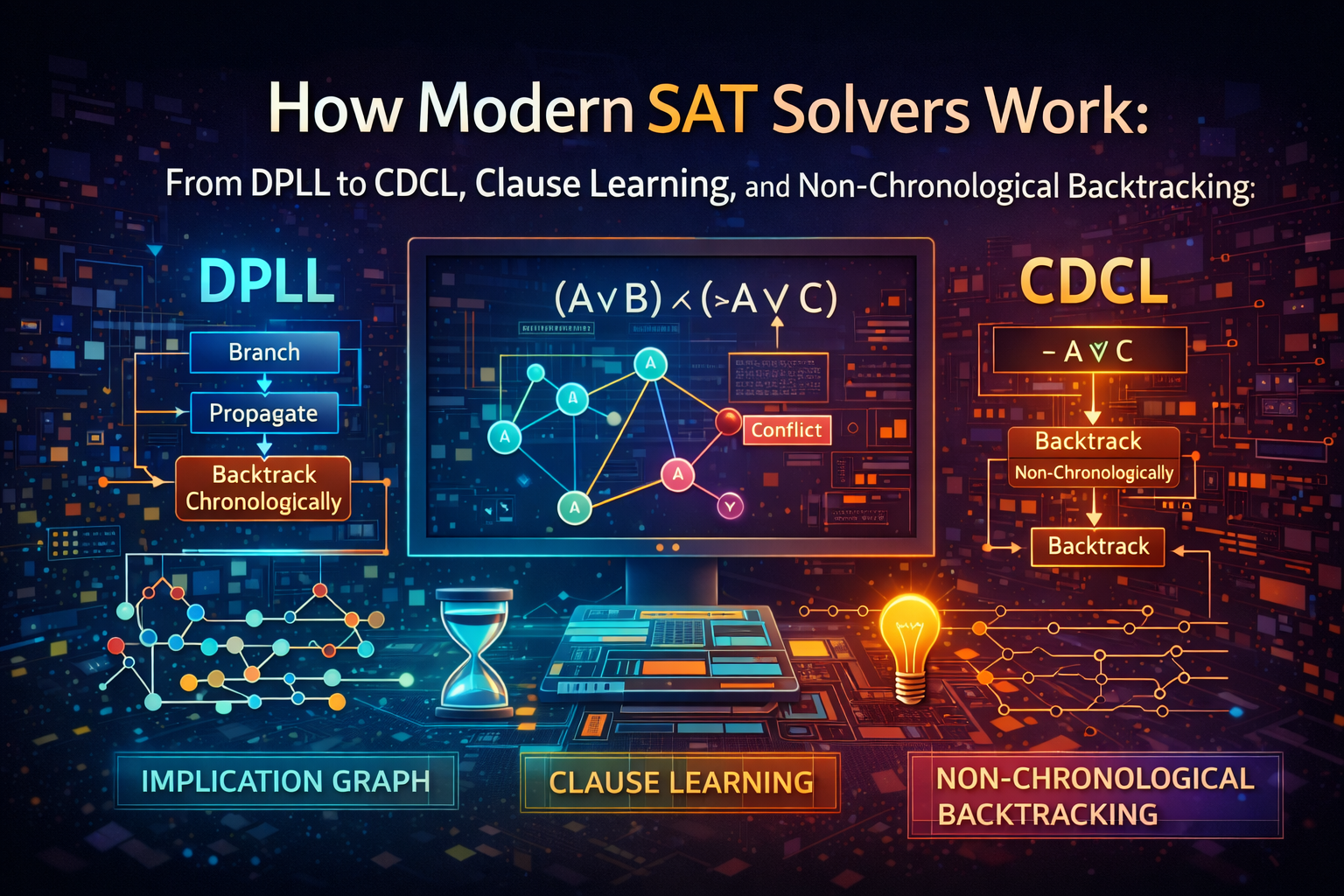
This article explains that progression in a structured way. It starts with the logic of classical backtracking search, then shows why plain DPLL hits performance limits, and finally explains how CDCL changes the game by learning from failure and jumping back to the right point in the search instead of undoing decisions one step at a time.
The Basic Setting: CNF, Clauses, and Assignments
Most SAT solvers work on formulas in conjunctive normal form, or CNF. A CNF formula is a conjunction of clauses, and each clause is a disjunction of literals, where a literal is either a Boolean variable or its negation. This representation matters because the main inference mechanisms used by SAT solvers, especially unit propagation and clause learning, are naturally defined on CNF formulas.
A solver’s job is to assign variables in a way that either satisfies all clauses or proves that no such assignment exists. At any moment, some variables may already be assigned and others may still be unassigned. Search therefore proceeds through a partial assignment, gradually extending it until a solution is found or a contradiction appears.
DPLL: The Classical Core
The Davis-Putnam-Logemann-Loveland procedure, usually called DPLL, is the historical foundation of most modern SAT solvers. In its familiar form, DPLL repeatedly performs unit propagation, checks for success or contradiction, chooses a branching literal, and recursively explores the consequences of that choice. Many later solver designs still preserve this overall search skeleton.
The key idea is simple. If propagation alone cannot settle the formula, the solver makes a decision, such as assigning a variable to true, and then pushes that choice forward through the formula. If that path leads to conflict, the solver backtracks and tries the alternative value.
This already gives DPLL surprising power. Even though SAT is hard in the worst case, DPLL can solve many structured instances effectively because propagation often shrinks the remaining search space much faster than blind enumeration would.
Unit Propagation: The Engine Inside DPLL
Unit propagation is the most important inference rule in classical SAT solving. If a clause becomes unit, meaning all but one of its literals are false under the current assignment, then the remaining literal must be true for the clause to be satisfied. The DPLL procedure repeatedly applies this rule until no more unit clauses remain or an empty clause appears.
This process does most of the real work inside a solver. Decisions are occasional, but propagation is constant. Every decision can trigger a cascade of implied assignments, and those implications are what expose contradictions or drive the formula closer to a solution.
In modern solver terminology, this stage is often called Boolean constraint propagation, or BCP. Chaff’s authors explicitly emphasized that efficient BCP was one of the main reasons for its large performance gains over earlier solvers.
Branching and Chronological Backtracking
When propagation reaches a fixed point without solving the formula, DPLL must branch. It selects a variable and assigns a value, thereby creating a new decision level in the search tree. If later propagation produces a contradiction, the solver backtracks.
In plain DPLL, that backtracking is chronological. The solver undoes the most recent decision first, then tries the alternative branch, and only then moves farther backward if necessary. The CDCL survey explicitly describes this as chronological backtracking and contrasts it with the non-chronological strategy used by modern solvers.
Chronological backtracking is correct, but it can be wasteful. A conflict often depends on decisions made much earlier than the last branch. If the solver only retreats one level at a time, it may revisit large portions of search space that are already doomed for the same underlying reason.
Why Plain DPLL Was Not Enough
The central weakness of basic DPLL is not that it reasons incorrectly. It is that it forgets too much. When a branch fails, classical backtracking merely reverses choices; it does not extract a reusable explanation of why that branch failed.
That means the solver can rediscover similar conflicts again and again. On hard formulas, especially industrial ones with deep structural dependencies, this repeated rediscovery becomes a major source of inefficiency. The search tree grows far larger than it needs to be because the solver is not learning from its mistakes.
Modern SAT solving changed when researchers stopped treating conflict as mere failure and started treating it as information. That shift leads directly to CDCL.
The Move from DPLL to CDCL
Conflict-driven clause learning, or CDCL, keeps the DPLL search framework but adds several crucial ideas. The solver still branches, propagates, and backtracks, but now it analyzes conflicts, derives new clauses from them, and uses those clauses to prune future search. The CDCL chapter explicitly states that the organization of CDCL solvers is primarily inspired by DPLL, but augmented with clause learning, efficient data structures, branching heuristics, restarts, and clause deletion policies.
This is why CDCL should be understood as an evolution rather than a replacement. It is not a different problem-solving philosophy altogether. It is DPLL upgraded with memory, explanation, and smarter recovery.
Historically, GRASP is one of the landmark systems here. Later surveys and empirical studies describe GRASP as introducing the now-standard pattern of analyzing a conflict, attaching a learned clause, and performing non-chronological backtracking.
What a Conflict Means in CDCL
In SAT solving, a conflict occurs when propagation makes some clause unsatisfied under the current partial assignment. In classical DPLL, that simply triggers backtracking. In CDCL, the solver goes further: it asks which chain of decisions and implications produced that contradiction.
This analysis is usually expressed through an implication graph. Decision assignments form roots at different decision levels, and propagated assignments are connected to the clauses that forced them. The conflict is then represented as a node that depends on incompatible assignments.
The power of CDCL comes from walking backward through that structure. Instead of merely saying “this branch failed,” the solver identifies a compact reason why it failed. That reason becomes a new learned clause.
Clause Learning: Turning Failure into a Constraint
Clause learning is the defining feature of CDCL. From a conflict, the solver derives a clause that prevents the same bad combination of assignments from being repeated. The CDCL survey explains that the learned clause can be justified by a sequence of resolution steps and that adding it preserves satisfiability equivalence.
This matters for two reasons. First, the learned clause prunes search immediately. Second, it also strengthens future propagation, because the new clause may later become unit much earlier in the search. In other words, learned clauses are not just records of past failure; they actively change the solver’s future behavior.
This is the point where SAT solving stops being simple tree search and becomes search plus incremental proof construction. Learned clauses accumulate logical knowledge about the instance.
Implication Graphs and Conflict Analysis
Conflict analysis works by tracing the implication graph backward from the conflict. The solver examines the variables implied at the current decision level, looks at their antecedent clauses, and resolves them until it obtains a learned clause with the right structure. The CDCL chapter describes this procedure in detail and ties it directly to the organization of modern solvers.
The learned clause is not arbitrary. A good clause should be logically valid, useful for pruning, and strong enough to justify jumping back more than one level. This is why conflict analysis is not just an explanatory tool; it is also an optimization strategy.
The better the analysis, the better the learned clause, and the more aggressively the solver can avoid redundant search. That is one reason conflict analysis became the intellectual center of modern SAT solving.
First-UIP Learning
Among the possible stopping points in conflict analysis, the most influential is the first UIP, or first unique implication point. The CDCL survey explains that although clause learning can stop at different UIPs, the most effective CDCL solvers in practice typically stop at the first UIP, and it notes that Chaff’s scheme became highly influential.
The first-UIP clause has an important operational property: it is usually assertive. After backtracking, it becomes unit and immediately forces a new assignment. That makes the learned clause highly useful, because it both prevents the old conflict and drives the search in a new direction right away.
This is one of the places where theory and engineering align beautifully. The learned clause is short enough to be manageable, strong enough to guide search, and structured enough to support non-chronological backtracking.
Non-Chronological Backtracking
Once a learned clause has been derived, the solver does not need to backtrack one level at a time. Instead, it can jump directly to the decision level where that learned clause becomes unit. This is non-chronological backtracking, also called backjumping.
The benefit is enormous. Instead of revisiting irrelevant recent decisions, the solver returns directly to the most informative point in the search. This is exactly why GRASP and later CDCL solvers were such a major step beyond plain DPLL.
Conceptually, non-chronological backtracking says that the last decision made is not always the real cause of failure. The learned clause identifies the true boundary of responsibility, and the solver jumps there.
Watched Literals and Fast Propagation
All of the high-level ideas in CDCL would be far less useful without fast propagation. Chaff’s most famous engineering contribution was the two-watched-literals scheme. Instead of revisiting every clause after every assignment, the solver watches two literals per clause and only inspects the clause when one watched literal becomes false.
The Chaff paper explains why this matters. If a clause still has two non-false watched literals, it cannot yet be unit. And when backtracking happens, the watched-literal structure does not need to be repaired clause by clause, which keeps unassignment cheap. The paper explicitly notes that this reduces memory traffic and makes backtracking constant-time at the clause-database level.
This is one of the clearest examples in SAT solving where a “data-structure trick” changes the practical frontier of the field. CDCL needed the logic of conflict learning, but it also needed the mechanics of cheap propagation.
Branching Heuristics and VSIDS
Even the best learning mechanism still leaves the question of which variable to branch on next. Chaff’s authors proposed VSIDS, short for Variable State Independent Decaying Sum, as a low-overhead branching heuristic especially suited to modern lazy clause data structures.
In Chaff’s description, each literal gets a counter. When a clause is added, the counters of its literals are incremented, and the solver periodically decays all counters by dividing them. The next branching choice favors literals with high current scores, which biases the search toward variables involved in recent conflicts.
The CDCL chapter later characterizes VSIDS as a conflict-driven branching heuristic that became central to modern solver design, precisely because it adapts quickly while keeping computation overhead low.
Why Conflict-Driven Branching Works
The deeper idea behind VSIDS is that conflicts reveal structure. Variables appearing in recent conflicts are often near the hard core of the instance, so choosing them again tends to generate informative propagation and informative learned clauses.
This is another hallmark of CDCL thinking. The solver is not just branching according to static frequency or random choice. It is letting the search process teach it where the difficult part of the formula lives.
Modern SAT solvers vary in their exact branching details, but the broad principle remains the same: search should be driven by feedback from conflicts, not only by the original input formula.
Restarts: Starting Over Without Forgetting
One of the more counterintuitive features of modern SAT solvers is restarting. A solver may intentionally abandon its current partial assignment and restart the search from an empty assignment, yet keep the learned clauses it has accumulated. The CDCL chapter lists periodic restart policies among the key techniques of modern solvers.
Why does this help? Because learned clauses reshape the problem. After enough learning, restarting does not mean “trying the same thing again.” It means searching a stronger formula with more pruning power than before.
Restarts also reduce the risk that a solver remains stuck exploring an unproductive part of the search space for too long. Combined with clause learning and conflict-driven branching, they often make search more robust on hard industrial instances.
Clause Database Growth and Deletion
Clause learning is powerful, but unchecked learning creates another problem: too many learned clauses. The CDCL survey explicitly notes that unrestricted recording can become impractical because learned clauses consume memory and can grow rapidly with the number of conflicts.
That is why modern solvers also need deletion policies. Some learned clauses remain extremely useful, especially short and active ones, while many others become noise. Good solvers therefore treat the learned-clause database as a managed memory of the search, not as an archive that must keep everything forever.
This is one of the subtle balances in CDCL. Learning is essential, but selective forgetting is also essential. Solver quality depends not only on how much it learns, but on whether it keeps the right lessons.
Why CDCL Was Such a Breakthrough
The reason CDCL transformed SAT solving is that it attacks the two biggest weaknesses of plain backtracking at once. It avoids relearning the same failures through clause learning, and it avoids retracing irrelevant steps through non-chronological backtracking.
Then, on top of those algorithmic improvements, systems such as Chaff added the engineering that made them fast enough in practice: watched literals for cheap propagation and low-overhead conflict-driven branching heuristics like VSIDS. Chaff’s paper reports one to two orders of magnitude speed improvements on difficult benchmarks through careful engineering of search, especially BCP and decision strategy.
That combination of logic and engineering is the real story of modern SAT solvers. No single trick explains their success. The performance comes from a stack of mutually reinforcing ideas.
From Research Prototype to Standard Solver Architecture
By the early 2000s, the broad structure of modern SAT solving had largely stabilized. A practical solver would usually be a CDCL engine with watched literals, a conflict-driven branching heuristic, first-UIP learning, non-chronological backtracking, periodic restarts, and learned-clause deletion. The CDCL survey explicitly presents these as the main ingredients of state-of-the-art solvers.
This does not mean innovation stopped. Later solvers refined clause minimization, restart schedules, simplification routines, proof logging, and portfolio techniques. But the intellectual core remained CDCL.
That is why understanding DPLL and CDCL is still the best way to understand SAT solving today. Even newer improvements usually make sense as extensions or refinements of this architecture, not as a complete departure from it.
The Bigger Lesson:
Modern SAT solvers are a powerful reminder that hard problems are often made tractable not by changing their worst-case complexity, but by exploiting structure, learning from failure, and engineering the inner loop relentlessly. SAT is still NP-complete. Yet state-of-the-art solvers are astonishingly effective on many real instances because they transform brute-force search into structured, feedback-driven reasoning.
DPLL provided the search skeleton. CDCL added memory. Clause learning turned conflict into knowledge. Non-chronological backtracking turned that knowledge into targeted recovery. Watched literals made propagation fast. VSIDS made decisions responsive to the evolving hard core of the instance. Restarts and clause deletion kept the whole process agile.
That layered progression is the reason SAT solvers became one of the great success stories of practical automated reasoning.
To understand how modern SAT solvers work, it is not enough to know that they “do backtracking.” Classical DPLL already performed branching and propagation, but it remained limited by chronological recovery and the absence of learning. CDCL changed the field by making conflict itself a source of reusable information.
Once clause learning, implication-graph analysis, first-UIP clauses, and non-chronological backtracking entered the picture, SAT solving became dramatically more focused. And once watched literals, VSIDS, restarts, and learned-clause management were engineered well, that focused reasoning became fast enough for major industrial use.
So the modern SAT solver is best seen as a refined DPLL machine that remembers, explains, jumps, and adapts. That is the journey from classical search to high-performance reasoning, and it remains one of the most elegant algorithmic evolutions in practical computer science.